Why Is Cosmetic Dental Marketing Different?
Cosmetic dentistry is elective, usually paid out of pocket, and often irreversible, so patients take longer to decide and judge a practice on evidence of skill and trust. General dentistry marketing wins on convenience and insurance. Cosmetic marketing wins by helping a cautious, research-heavy prospect feel confident enough to book a consultation.
A cleaning patient wants an open slot near work that accepts their plan. A veneer prospect is weighing a permanent change to their face. The ADA's MouthHealthy page on veneers notes that enamel is removed to place them, that the treatment cannot be reversed, and that veneers may not suit people who grind their teeth or have untreated decay or gum disease.
Three practical differences follow:
- Longer research cycle. The same person may return several times over weeks.
- Higher trust threshold. Real cases and named dentists outweigh discounts.
- Different conversion goal. The goal is a qualified consultation, not a same-day booking.
What Do Patients Search Before Choosing Veneers?
Veneer research usually moves from broad questions ("are veneers worth it," "porcelain vs composite veneers") to comparison searches ("veneers vs bonding," "how long do veneers last") and finally local, commercial searches such as "porcelain veneers Beverly Hills" or "cosmetic dentist Santa Monica consultation."
It helps to sort these queries into three intent groups, because each needs a different page:
- Informational: how veneers work, who may not be a candidate, maintenance, alternatives like whitening, bonding, or orthodontics.
- Commercial investigation: dentist comparisons, smile gallery browsing, reviews, financing questions, "best cosmetic dentist" searches.
- Transactional local: treatment plus neighborhood, "near me," and consultation-booking searches.
General dentistry intent ("dentist open Saturday," "dentist that takes Delta Dental") belongs on general pages, not a veneers page where it frustrates visitors and blurs reporting. Before assigning a keyword, check the live results: if Google shows mostly articles, an informational page will compete better than a sales page.
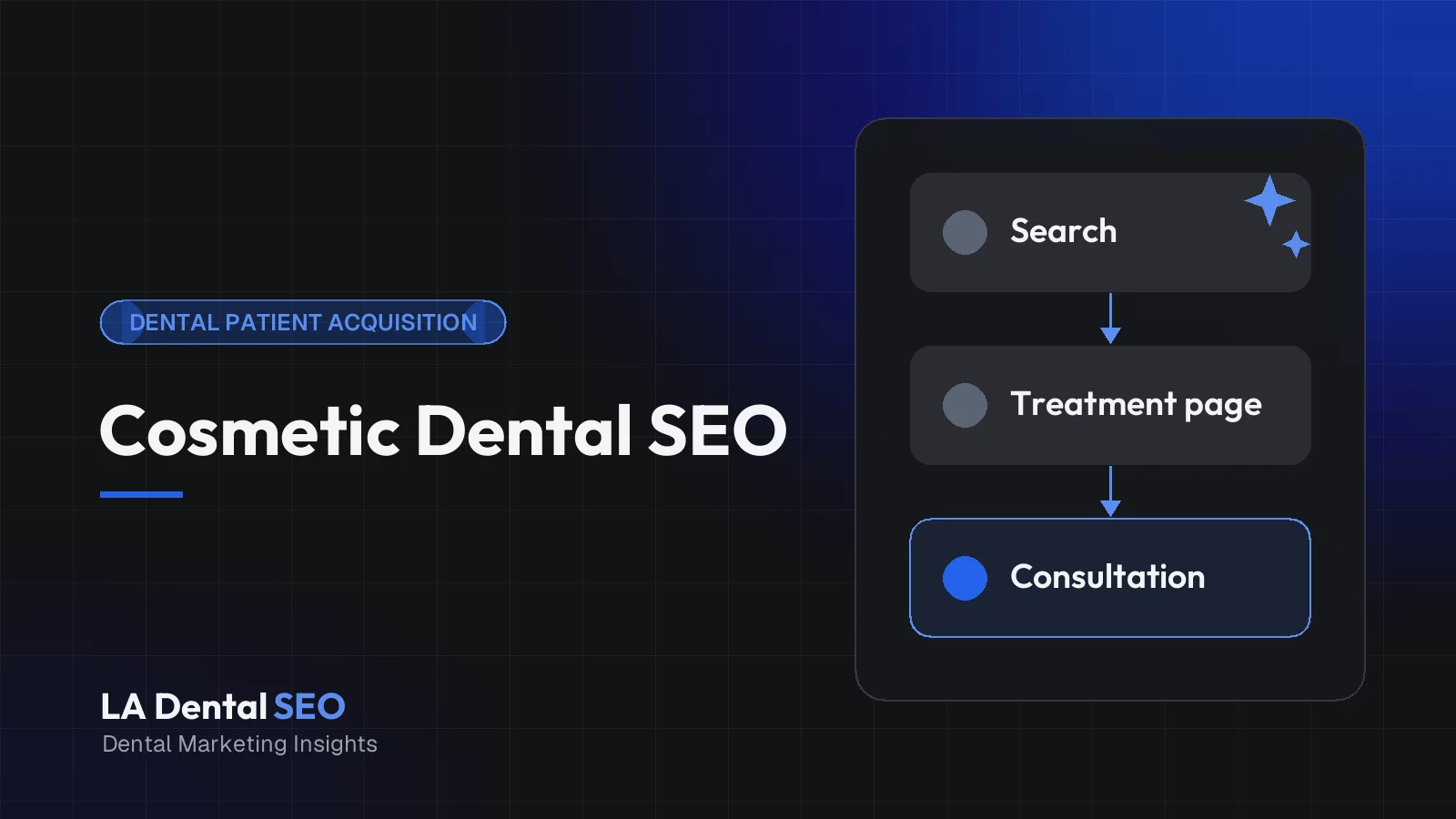
From Cosmetic Dentistry Search to Consultation Request
- Patient researchProspects compare treatments and providers; many leave when results only show generic dental pages.
- Treatment-specific landing pageA dedicated veneers page holds attention; visitors drop off when content is vague or hides candidacy limits.
- Verified credentials and evidenceNamed dentists and authorized case photos build trust; stock images and unverifiable claims push people away.
- Clear consultation informationExplain what the visit includes and how fees or financing are discussed; uncertainty here stalls many prospects.
- InquiryA short form, call, or text option; long forms and slow replies are common exit points.
- Appointment confirmationPrompt, personal follow-up confirms the visit; unanswered inquiries often book with a competitor instead.
How Should Cosmetic Dental Keywords Be Organized?
Group keywords by treatment and intent, then assign each group one primary page. Commercial treatment searches belong on dedicated service pages, informational questions belong in articles or FAQs that link to those pages, and general dentistry terms stay on general pages. One page per primary intent prevents cannibalization.
The illustrative mapping below should be adapted to the treatments you actually provide.
| Keyword cluster (examples) | Primary intent | Suggested destination |
|---|---|---|
| porcelain veneers Beverly Hills, veneers consultation West LA | Transactional local | Porcelain veneers service page |
| porcelain vs composite veneers, veneers vs bonding | Informational / comparison | Educational article linking to the veneers page |
| smile makeover Santa Monica, full smile makeover options | Commercial investigation | Smile makeover page with case gallery |
| cosmetic dentist West Hollywood, best cosmetic dentist near me | Commercial local | Cosmetic dentistry hub page plus Google Business Profile |
| do veneers ruin your teeth, who should not get veneers | Informational / concern | Candidacy FAQ section on the veneers page |
| teeth cleaning Beverly Hills, dentist that takes PPO | General dentistry | General dentistry or insurance page |
Avoid cloned pages for "veneers Beverly Hills," "veneers West LA," and "veneers 90210," and do not let the homepage compete with the veneers page. Google's guidance on helpful, people-first content warns against content made mainly to attract search visits rather than to help people.
What Makes an Effective Veneers Landing Page?
An effective veneers page answers the questions a cautious prospect brings: what veneers are, porcelain versus composite, who may not be a candidate, what the consultation involves, how cost and financing are discussed, and who performs the work. It pairs that information with authorized case photos and one clear next step.
A practical outline:
- A plain-language opening that names the treatment and location without hype.
- Candidacy and alternatives, including when whitening, bonding, or orthodontics may be a better fit.
- The process, from consultation and planning to placement and maintenance.
- The treating dentist, with real training and memberships linked to a bio page.
- Authorized before-and-after cases with honest captions.
- Cost factors and financing options, explained without invented price claims.
- A short FAQ that addresses fears: sensitivity, longevity, replacement, reversibility.
- One consistent call to action repeated at sensible points.
Pages built this way often attract fewer casual clicks and more serious inquiries. If your current page does not convert, our article on why dental websites fail to convert visitors covers form design, speed, and mobile layout in more depth.
Why Do Real Credentials and Authorized Galleries Matter?
Prospective cosmetic patients choose a dentist largely on evidence of skill and honesty. Real names, verifiable training, and before-and-after photos used with documented patient authorization build that trust. Stock smiles, borrowed cases, or retouched images can mislead patients and conflict with professional ethics and advertising rules.
The ADA's Code of Ethics, Section 5 (Veracity) says dentists must not advertise in a false or misleading way, including content likely to create unjustified expectations about results. It also limits how dentists announce specialization, which matters when a general dentist describes cosmetic expertise. Have the practice's legal or compliance advisor review how credentials are worded.
For testimonials and reviews, the FTC's guidance on endorsements and reviews addresses fake reviews and the disclosure of material connections, such as patients who received a discount in exchange for a video. A workable gallery standard:
- Written authorization on file for every published photo
- Cases treated by the dentist named on the page
- No editing that changes the clinical result
- Captions that describe the treatment, not a promised outcome
- Any incentive given to a patient for a testimonial disclosed clearly
How Do Beverly Hills, West Hollywood, and Santa Monica Differ?
Each area has its own competitor density, search language, and patient expectations, so one Westside page rarely serves all three. Local visibility depends heavily on proximity, which means a Beverly Hills office cannot assume it will appear for Santa Monica searches simply by mentioning the city.
Illustrative example: a Beverly Hills office near Wilshire Boulevard may have many established cosmetic competitors within a few blocks, so Maps visibility depends on reviews, profile completeness, and relevance. A Santa Monica practice may draw searches that mix cosmetic and family needs, which makes clean intent separation on the site more important.
- Study the actual Maps results from inside each neighborhood rather than from your office.
- Create a neighborhood page only where you genuinely serve patients, with unique content.
- Keep your Google Business Profile name matched to your real-world name; adding keywords like "Veneers" can risk suspension.
For a deeper look at local ranking, see our guide to the Google Maps 3-Pack for LA practices.
How Can SEO and Google Ads Support Each Other?
Google Ads can place a veneers page in front of high-intent searches immediately while organic visibility develops, and search term data from ads shows which phrases produce real consultations. SEO then builds durable visibility for the terms that convert. Each channel makes the other's budget decisions better informed.
A sensible split: ads for narrow commercial terms ("porcelain veneers consultation Beverly Hills") with a strong landing page, SEO for broader research questions. Our dental SEO and Google Ads services are built around that division. Review the search terms report regularly and add negatives for low-fit queries such as "cheap veneers," "DIY," or "veneers abroad" if those do not match your practice.
Know the limits. Google's personalized advertising policy on health lists invasive medical procedures, including cosmetic surgery and surgical procedures, as restricted health content, and restricted categories cannot use advertiser-curated audiences such as remarketing lists. Ask your ads manager how this applies to your campaigns rather than assuming follow-up ads will be available.
How Should Cosmetic Practices Qualify Consultation Leads?
Qualify by fit and readiness, not by wealth. Ask which treatment the person is interested in, what they hope to change, their preferred timing, and whether they want to discuss financing. Then let the dentist decide candidacy at the consultation, since many inquiries will need a different treatment or none.
A respectful screening framework:
- Interest: veneers, whitening, bonding, aligners, smile makeover, not sure.
- Goal: chips, discoloration, gaps, shape, overall appearance.
- Timing: exploring, within three months, specific event date.
- Budget conversation: would they like information about payment options?
Avoid asking for medical history on a marketing form. Health details belong in the practice's secure intake process.
What Website Features Improve Consultation Requests?
The features that help most reduce uncertainty and effort: a short consultation form, click-to-call and text options on mobile, a clear explanation of what happens at the first visit, easy-to-find galleries, financing information, and fast response times. Fancy animation rarely matters as much as clarity.
Audit checklist:
- Consultation button visible without scrolling on mobile
- Form asks for five fields or fewer, with an optional treatment dropdown
- "What to expect at your consultation" section on every treatment page
- Financing partners named, with a link to terms
- Stated response window, such as one business day, that the team actually meets
You can see examples of these structural changes in our before-and-after website transformations.
What Metrics Should Cosmetic Practices Monitor?
Track the path from search to treatment acceptance: organic and paid visits to cosmetic pages, consultation requests by treatment, response time, consultations scheduled and attended, and treatment plans accepted. Rankings and traffic are useful early signals, but only the later stages show whether marketing attracts the right patients.
A simple weekly scorecard:
- Cosmetic page entrances by source (organic, Maps, ads).
- Consultation inquiries tagged by treatment interest.
- Median time to first response.
- Consultations booked and attended.
- Treatment plans presented and accepted, recorded in the practice management system.
Connect stages 4 and 5 to the original source. Otherwise you may keep funding the campaign with the most inquiries rather than the one producing accepted cases.
A 90-Day Cosmetic Dental Marketing Action Plan
Spend the first month on measurement and intent mapping, the second on rebuilding your most important treatment page and Business Profile, and the third on supporting content, ads testing, and follow-up processes. Ninety days is enough to fix foundations and gather data, not to guarantee rankings or case volume.
Days 1–30: Measure and map
- Set up call, form, and booking tracking with treatment tags.
- Build your keyword-to-page map and identify overlapping pages.
- Collect written authorization for any cases you plan to publish.
Days 31–60: Rebuild the core
- Rewrite the veneers or smile makeover page using the outline above.
- Update dentist bios with verifiable credentials.
- Complete and correct the Google Business Profile, including services and photos.
Days 61–90: Support and refine
- Publish two or three articles answering real candidacy and comparison questions.
- Run a narrow ads test on commercial veneer terms.
- Review inquiry quality with the front desk and adjust forms and scripts.
Not sure where to start? A free dental SEO audit can show which step needs attention first.
Key Takeaways
- Separate cosmetic, informational, and general dentistry search intent, and give each primary intent one page.
- Build veneers and smile makeover pages that explain candidacy limits, the consultation, and cost factors honestly.
- Publish only authorized, unaltered case photos and verifiable credentials.
- Use Google Ads for narrow commercial terms and check Google's health targeting restrictions before planning remarketing.
- Measure consultations attended and treatment accepted by source, not just traffic.
Frequently Asked Questions
Should we publish veneer prices on our website?
That is a business decision. Many practices explain cost factors (number of teeth, material, preparatory treatment) and financing without a fixed number. If you publish figures, keep them accurate, current, and clear about what is included.
How long does cosmetic dental SEO take to show results?
It varies with competition, your site's history, and how much needs fixing. Technical and content improvements can be completed within weeks, but organic visibility in competitive Westside markets usually develops over months, and no one can promise a timeline.
Can we use patient smile photos from Instagram on our website?
Only if the patient has authorized that use. Consent for one channel does not automatically cover another, so use a written authorization that names the channels where images will appear.
Attract Fewer Wrong Clicks, More Right Consultations
Cosmetic patient acquisition works best when search intent, trustworthy pages, and fast follow-up line up. If you want a clear view of where your Westside practice stands, LA Dental SEO can review your cosmetic pages, local visibility, and inquiry process with you.
Talk With a Cosmetic Dental Marketing SpecialistSources and Further Reading
- Creating Helpful, Reliable, People-First Content, Google Search Central.
- Veneers, MouthHealthy, American Dental Association.
- Code of Ethics, Section 5: Principle of Veracity, American Dental Association.
- Endorsements, Influencers, and Reviews, Federal Trade Commission.
- Health in Personalized Advertising, Google Advertising Policies Help.
- Guidelines for Representing Your Business on Google, Google Business Profile Help.