What Is the Google Maps 3-Pack for Dentists?
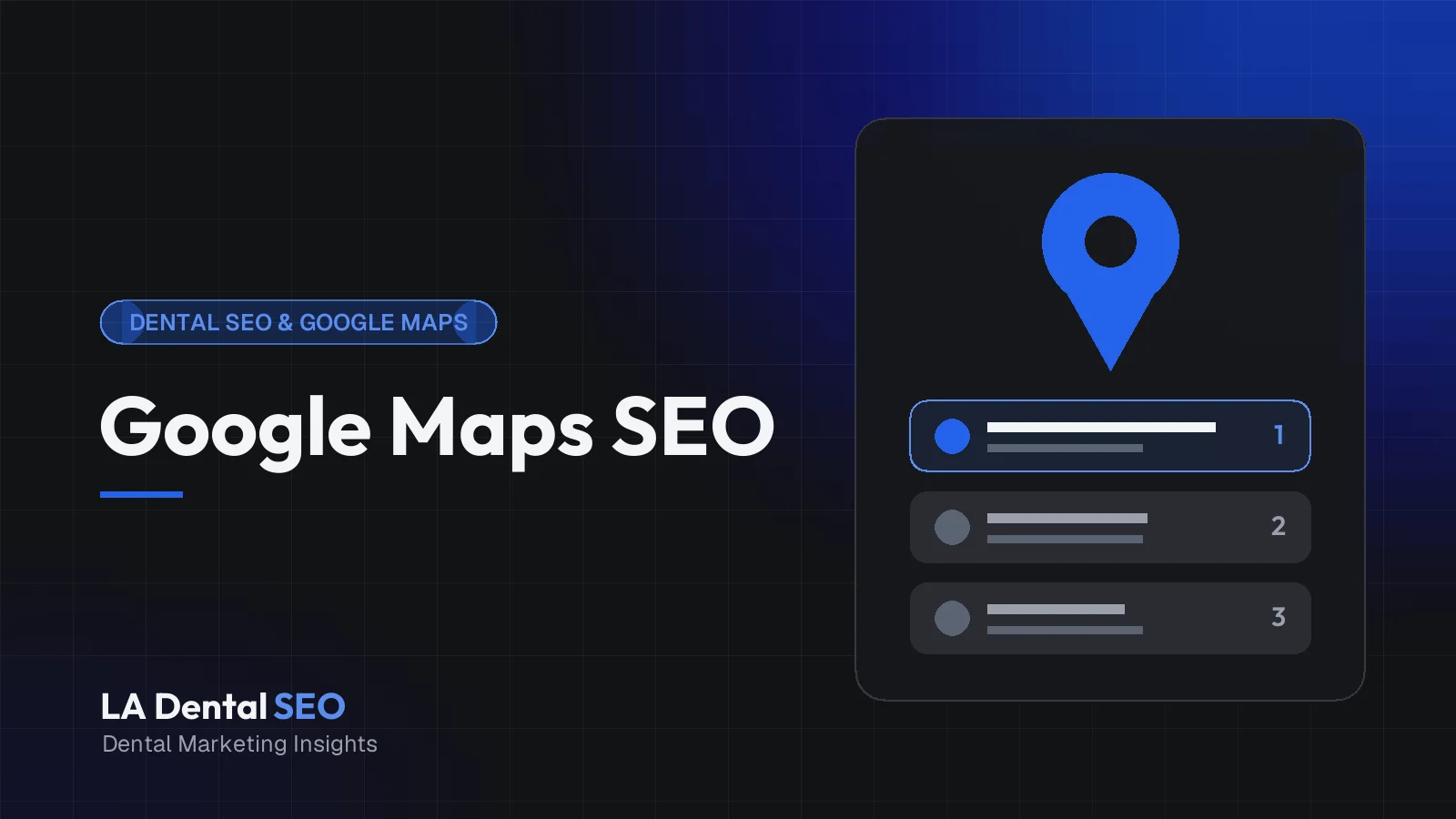
The 3-pack is the small group of business listings Google shows beside a map when a search has local intent, such as "dentist near me" or "emergency dentist Silver Lake." It matters because patients can call, get directions, or open your website straight from those listings, often without scrolling further.
The name is shorthand. Layouts change, sponsored listings can sit above the organic ones, and the Maps app shows a longer list. The behavior stays constant: a patient with a toothache or a new insurance card wants a nearby office they can trust, and decides quickly. Many will see your rating, hours, photos, and call button before your website, which makes the profile a second homepage. If it is thin or outdated, you can lose the patient even when you appear.
What Factors Determine Local Google Maps Rankings?
Google says local results are based mainly on relevance, distance, and prominence: how well a profile matches the search, how far the business is from the searcher, and how well-known the business is. Google does not publish a complete factor list or the weight of each signal.
Google's local ranking help page describes these considerations and adds a line worth remembering when a vendor pitches you: there is no way to request or pay for a better local ranking. Google Ads can place a labeled ad near the map, but that is advertising, not organic placement.
Three Foundations of Google Local Visibility
- RelevanceHow closely your categories, services, profile details, and website match what the patient searched. Largely within your control.
- DistanceHow far your real office is from the searcher or the searched location. Largely outside the practice's control.
- ProminenceHow well-known the practice appears, informed partly by reviews, ratings, and links from other websites. Built gradually.
Relevance is matching. When a patient searches "pediatric dentist," Google looks for profiles and websites that clearly describe pediatric care. Your categories, services, description, and linked pages all feed that understanding, and Google notes that complete, accurate profiles are more likely to appear in relevant results.
Distance is measured from the searcher, or from the place named in the search. A Culver City office will rarely win a Pasadena patient's "dentist near me" search, however polished its profile.
Prominence reflects reputation. Google says it draws partly on links to your business and your reviews, and that more reviews and positive ratings can help. It builds slowly, which is why it attracts policy-breaking shortcuts.
How Do You Audit a Dental Google Business Profile?
Start with the facts Google checks against the real world: business name, a staffed address, categories, hours, phone number, and website links. Then review services, appointment links, and photos. Fix accuracy and policy problems before chasing completeness, because errors cause suspensions, missed calls, and confused patients.
Use Google's guidelines for representing your business as the reference, and write down what you find before changing anything.
Correct business name
Use your real-world name as it appears on signage and your website. Google does not permit added taglines, service keywords, or neighborhoods. "Sunset Family Dental" is fine; "Sunset Family Dental | Best Invisalign Dentist LA" is not, even if a competitor gets away with it for now. Dentists may also have practitioner profiles; in a shared office, the practice holds the location profile and each practitioner profile uses only the dentist's name.
Real location eligibility
The address must be a real location where patients are seen during stated hours. P.O. boxes, virtual offices, and mailbox addresses are ineligible, and each location gets one profile. A prestige mailing address in Beverly Hills is not a second office. Include your suite number so patients can find you.
Primary and secondary categories
Google asks for the fewest categories that describe your core business, framed as "this business is a," not "this business has a." The primary category should reflect most of what you do, such as Dentist, Cosmetic dentist, or Pediatric dentist. Add secondary categories only for genuine parts of the practice, and confirm current names inside your profile, since the list changes.
Hours and phone number
List regular patient-facing hours and add holiday hours before the holiday. Use a local number that reaches the office and is under the practice's direct control. If you use call tracking, review Google's current guidance first and keep your main number on the profile.
Website and appointment links
Link each profile to the page that best represents that office, usually its location page in a multi-office group. Confirm the appointment link opens a working booking page. UTM parameters on these links let you separate profile traffic in analytics.
Services and photographs
List treatments you actually provide, in plain language that matches your website. Upload real photos of the exterior, entrance, parking, reception, and team. There is no published evidence that photo volume raises rankings, so choose photos that answer practical questions, like which door to use.
How Can Dental Practices Improve Local Search Relevance?
Relevance improves when every source describes the practice the same specific way: accurate categories, a services list reflecting real treatments, a website page for each major service and each office, and consistent location details. Repeating keywords does not add relevance. Specific, accurate, consistent information does.
- Map services to pages. If implants, emergencies, and pediatric care drive your schedule, each deserves a page the location page links to.
- Describe the office, not the city. Cover cross streets, parking, transit, accessibility, and languages your team actually speaks.
- Use attributes honestly. Select only profile attributes that are true.
- Keep the description factual. A few clear sentences on who you serve, not a list of neighborhoods.
How Do Reviews and Reputation Affect Local Visibility?
Google says more reviews and positive ratings can help local ranking, and that replying shows you value feedback. Reviews also decide whether a patient calls. Aim for a steady stream of genuine reviews from a fair cross-section of patients, requested without incentives, filtering, or scripted wording.
Google's Maps content policy is explicit. Practices may not offer discounts, free whitening, or other incentives for reviews; ask only happy patients or discourage negative reviews; request specific content; pressure patients to post in the office or set staff review quotas; or accept reviews from employees, relatives, or others with a conflict of interest.
What works within those rules is unglamorous: ask every patient the same neutral way at a consistent moment, such as a follow-up text with a direct link, and reply regularly. Dental replies carry a privacy risk general businesses do not face, because confirming someone is a patient or mentioning treatment can create problems. Our guide to privacy-conscious review requests and replies covers the wording.
Why Do Some Los Angeles Dentists Outrank Nearby Competitors?
Usually because of several differences at once: one office sits closer to where most searches happen, uses a better-fitting primary category, links to a stronger location page, has more recent reviews, or earns more local mentions. It is rarely one factor, and advantages like location cannot be copied.
First, check how you measure. A search from your front desk shows how you rank from your front desk. Results shift with the searcher's position, wording, and device. Grid-based rank trackers, which sample results from many points around your office, show where you are strong and where you fade.
Illustrative example: two general practices in Koreatown sit four blocks apart. Practice A appears across most of the neighborhood; Practice B only near its own block. Practice A uses Dentist as its primary category, links to a detailed location page, and replies to reviews in English and Korean. Practice B chose Cosmetic dentist although most patients come for general care, links to its homepage, and has had no new review in eight months. None of those fixes is exotic, and together they plausibly explain much of the gap. Even after fixing them, Practice B should expect A to keep winning searches made outside A's door.
When comparing, review the same items in order: primary category, name compliance, review count and recency, the linked page, service page depth, and local mentions such as sponsorships or news coverage. If a competitor stuffs keywords into its name, you can suggest an edit on Maps, but build your plan around your own improvements.
What Should Dental Practices Fix on Their Websites?
Your website should confirm what your profile claims: matching name, address, and phone, a dedicated page for each real office, service pages that explain actual treatments, fast mobile pages with tap-to-call, and working appointment paths. Structured data can clarify these details, but it does not guarantee placement.
- Consistent contact details, including suite numbers, matching the profile exactly.
- A real location page per office with hours, parking, directions, the dentists who practice there, services offered, and insurance details you can verify.
- Service pages with substance, explaining who a treatment suits and what a visit involves, reviewed by a dentist.
- Mobile usability. Maps visitors are often on a phone; a visible call button beats animation.
- Accurate structured data. Google's local business documentation recommends the most specific subtype available (Schema.org includes Dentist) and states that features using structured data are not guaranteed. Our schema markup guide for dentists shows accurate examples.
Our dental SEO and Business Profile services cover both sides of this checklist if you want a second set of eyes.
Beverly Hills, Santa Monica, Pasadena, and Downtown LA
These markets differ in how many practices compete within a short distance, what patients look for, and how they reach an office. Strategy should follow your real office location and the patients who can realistically reach it, not a list of neighborhood names added to a profile or page.
Treat the notes below as planning considerations to check against your own data, not measured facts.
- Beverly Hills: many dental and specialty offices operate within a few blocks, so any one practice's effective radius can be small. Specific treatment pages, clearly presented credentials, authorized smile photos, and medical-building suite and parking details help patients choose.
- Santa Monica: patients include residents, nearby workers, and Westside families. Parking, transit, and early or weekend hours are worth stating plainly.
- Pasadena: it functions as its own city, and many patients search with its name. A Pasadena office competes mainly with San Gabriel Valley practices, so its page should speak to that community.
- Downtown LA: residents mix with a large daytime workforce. Work-friendly hours, building access instructions, parking validation, and entrance photos matter; a high-rise suite patients cannot find loses calls regardless of rank.
Each real office needs its own profile and page. Pages for neighborhoods where you have no office rarely help and can look like doorway content. See our article on neighborhood SEO for multi-location practices and the Los Angeles areas we serve.
Common Google Business Profile Mistakes
Most dental profile problems are maintenance gaps and well-meaning shortcuts, not strategic failures:
- Keywords in the name, which can lead to suspension or a forced name change.
- An ineligible address, such as a virtual office or unstaffed second suite.
- Category overload that blurs what the practice is.
- Forgotten holiday hours, which send patients to a locked door.
- Duplicate or outdated profiles from old addresses or departed dentists, splitting reviews.
- Unchecked public edits. Anyone can suggest changes, so review the listing regularly.
- Frequent edits to core details, which can send a profile into review. Change things deliberately, once.
A Practical 30-Day Dental Maps Improvement Plan
Thirty days is enough to fix accuracy, align the profile with the website, start a sustainable review process, and set a baseline. It is not enough to judge ranking results, which depend on competitors, distance, and how quickly Google processes changes.
| Week | Focus | Key tasks | Output |
|---|---|---|---|
| 1 | Accuracy and eligibility | Confirm ownership; check name, address, suite, phone, and hours against guidelines; resolve duplicates. | A log of every fix and why |
| 2 | Relevance alignment | Review categories; complete services; link the right location page; add UTM tags. | Profile and website describing the same practice |
| 3 | Website and photos | Strengthen location and top service pages; fix tap-to-call; upload current entrance, parking, reception, and team photos. | Pages that answer practical questions |
| 4 | Reviews and measurement | Send one neutral review request to all patients; set a reply routine; record calls, clicks, direction requests, and grid snapshots. | A baseline for monthly comparison |
Then move to a monthly rhythm: check for public edits, reply to reviews, refresh photos when something changes, and compare patient actions with the baseline. Our step-by-step process shows how we structure this work.
Key Takeaways
- Use relevance, distance, and prominence as your working model; Google does not publish factor weights.
- Audit for eligibility first: a staffed address, a real-world name, and the fewest accurate categories.
- Link each profile to a strong location page so Google and patients see the same facts.
- Ask every patient for reviews the same neutral way, with no incentives, filtering, or requested wording.
- Measure from many points around the office and judge success by calls and bookings.
Frequently Asked Questions
How long until Maps visibility changes?
There is no fixed timeline. Profile corrections may appear within days once processed, while reputation gains build over months. Compare monthly trends rather than daily positions.
Can I rank in a neighborhood where I have no office?
You may appear for some searches near the edge of your natural area, especially when a search names a place, but not consistently far from your address. Fake locations violate Google's guidelines.
Should each dentist have a separate profile?
Google allows practitioner profiles for dentists reachable at the verified location during stated hours. They collect their own reviews, so decide deliberately, and keep the practice profile as the main listing.
Do Google Ads improve Maps rankings?
No. Google states there is no way to pay for better local ranking. Ads can place a labeled listing near the map, separate from organic results.
Do Business Profile posts help rankings?
Google does not list posts as a ranking factor. They remain useful for sharing news, new services, or holiday hours with patients viewing your profile.
Make Your Maps Listing Work Harder
Maps visibility comes from accurate information, genuine reputation, and a website that backs up your profile, measured by the patients who actually call. If you want help deciding which fixes matter most for your office, let's talk it through.
Book a Free Google Maps ConsultationSources and Further Reading
- Tips to improve your local ranking on Google, Google Business Profile Help.
- Guidelines for representing your business on Google, Google Business Profile Help.
- Prohibited and restricted content, Maps User Generated Content Policy Help.
- Understand your Business Profile performance and insights, Google Business Profile Help.
- Local Business (LocalBusiness) structured data, Google Search Central.