Why Does Dental Implant Marketing Need a Different Strategy?
Implant treatment involves surgery, a longer timeline, significant cost, and a candidacy assessment that only a clinician can make. Patients research carefully, often involve family members, and compare providers on credentials and clarity. Marketing has to inform and qualify without implying that anyone is a candidate before an exam.
The ADA's MouthHealthy overview of dental implants notes that general health matters more than age, that conditions such as diabetes may affect healing, and that tobacco use can slow it. Those are clinical factors, but they shape marketing too: a page that ignores candidacy invites inquiries that end in disappointment, wastes chair time, and damages trust.
Google also holds health content to a higher standard. Its guidance on helpful, reliable content explains that its systems give extra weight to content showing strong experience, expertise, authoritativeness, and trustworthiness on topics that could significantly affect people's health or financial stability. Implant content touches both.
The Dental Implant Patient Acquisition Journey
- Treatment researchMarketing responsibility: publish accurate, clinician-reviewed education that matches each search intent.
- Comparing providersMarketing responsibility: clear location pages, accurate Business Profiles, and authorized cases.
- Evaluating credentials and optionsMarketing presents verified credentials; the clinical team defines which treatment options are described.
- Consultation inquiryMarketing and front desk: short forms, fast replies, and simple non-clinical qualifying questions.
- Clinical consultationClinical decision: the dentist examines, diagnoses, and determines candidacy and treatment options.
- Practice follow-upTeam responsibility: answer questions and explain financing; clinical recommendations remain the clinician's.
What Are the Most Important Implant Search Intents?
Most implant searches fall into five intents: learning about implants, replacing a single tooth, replacing several teeth or a full arch, understanding cost and financing, and urgent problems with an existing tooth or restoration. Each intent signals a different stage, a different patient, and a different page.
- Educational: "how do dental implants work," "implants vs bridge."
- Single-tooth commercial: "single tooth implant near me."
- Full-arch research: "permanent teeth instead of dentures," "full mouth implants."
- Cost and financing: "implant cost," "implant payment plans."
- Urgent: "implant crown fell off," "broken front tooth emergency."
Full-arch prospects usually spend the longest researching. They often read about denture alternatives, watch explanation videos, and compare several practices before calling. That makes them the audience most likely to reward thorough, honest content, and the audience most likely to leave when a page feels like a sales pitch.
How Should Implant Keywords Be Grouped?
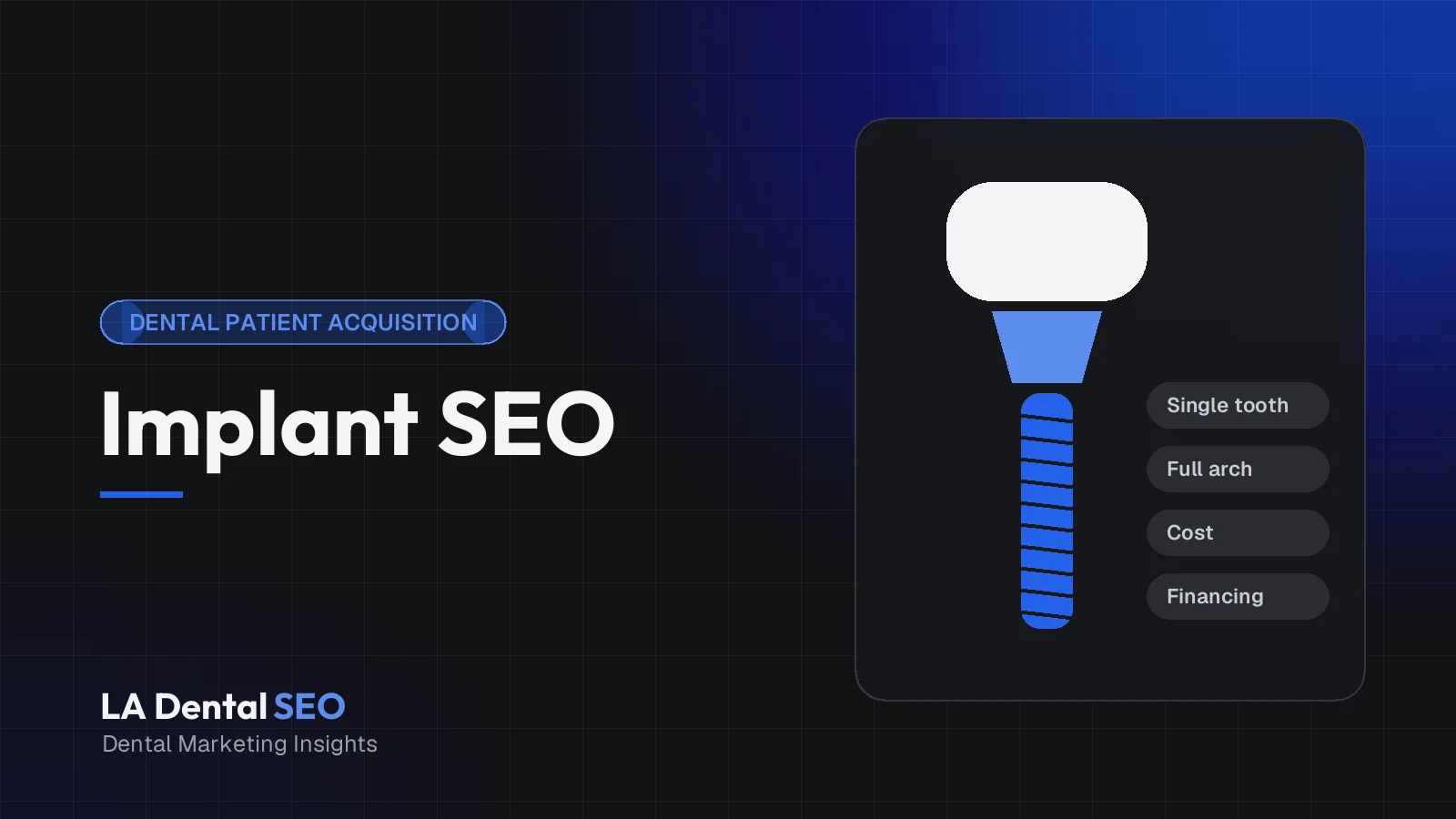
Group implant keywords into six clusters: single-tooth, multiple teeth, full-arch restoration, All-on-4 treatment, cost, and financing. Assign each cluster an intent and one primary page type. This keeps pages focused, avoids several pages competing for the same search, and makes campaign data easier to interpret.
| Cluster | Example searches | Primary intent | Suggested page type |
|---|---|---|---|
| Single-tooth implants | single tooth implant, replace one missing tooth | Commercial, near-term | Single-tooth implant service page |
| Multiple implants | implant bridge, replace several missing teeth | Commercial investigation | Multiple-tooth options page comparing approaches |
| Full-arch restoration | full mouth dental implants, alternatives to dentures | Long research, high consideration | Full-arch hub page with FAQs and consultation steps |
| All-on-4 treatment | All-on-4 near me, All-on-4 consultation | Commercial, brand-specific | Protocol page only if the practice offers it |
| Implant costs | dental implant cost, full arch implant price factors | Informational with commercial intent | Cost-factors guide linking to service pages |
| Financing questions | implant financing, payment plans for implants | Decision-stage | Financing page or section with terms explained |
A note on terminology: Nobel Biocare presents the All-on-4® treatment concept under a registered trademark. Use the term only if your clinicians actually provide that protocol; otherwise describe your approach as full-arch implant treatment and explain it in your own words. Your attorney can advise on trademark use.
What Should a Strong Implant Service Page Include?
A strong implant page explains the treatment in plain language, describes who may and may not be a candidate, outlines the process and timeline in general terms, names the clinicians involved, shows authorized cases, explains cost factors and financing, and makes the consultation step clear. It informs first and sells second.
- Plain-language definition and how it differs from bridges and dentures
- Candidacy factors, with a clear statement that an exam determines eligibility
- General treatment stages, without promising a specific timeline
- Named surgeon and restoring dentist, linked to bio pages
- Authorized before-and-after cases treated at your practice
- Cost factors and financing options
- What happens at the consultation, including imaging if applicable
- FAQ covering pain, recovery, maintenance, and risks
Do not publish success rates or outcome claims unless they are accurate, sourced, and reviewed. A practice's own unverified numbers presented as fact can mislead patients and invite regulatory problems.
Why Do Credentials and Clinical Review Matter?
Implant patients are choosing who will perform surgery, so they look closely at training and experience. Clinical review of every page protects accuracy, while precise credential wording protects the practice. Vague or inflated claims can mislead patients and conflict with dental ethics standards on advertising and specialty announcements.
The ADA's Code of Ethics, Section 5 prohibits false or misleading advertising, including claims that create unjustified expectations about results. It also restricts "specialist" announcements to recognized specialties and asks general dentists who announce services in specialty areas to state that the services are provided by general dentists. That matters on implant pages, where periodontists, oral surgeons, prosthodontists, and general dentists may all be involved.
A practical review workflow:
- Marketing drafts the page from approved talking points.
- The treating clinician reviews clinical accuracy and candidacy language.
- The office manager confirms financing and policy details.
- The page shows who reviewed it and when it was last updated.
How Should Multi-Location Implant Practices Organize Websites?
Keep one domain with shared treatment pages that hold the deep clinical explanations, then build a genuine page for each location with its own address, clinicians, hours, and services actually available there. Each location should have its own accurate Google Business Profile. Avoid cloning the same implant page per city.
Illustrative example: a group with offices in Pasadena, Torrance, and Sherman Oaks offers single-tooth implants everywhere but full-arch treatment only in Pasadena, where its surgeon and imaging equipment are based. The full-arch hub page should say so clearly, the Pasadena location page should feature it, and the other location pages should explain the referral path. Patients prefer a clear answer to discovering it at the front desk.
- Use a consistent URL pattern for locations and treatments.
- Follow Google's guidelines for representing your business: real-world names only, no keywords like "Implant Center" added to the profile name unless it is the actual business name.
- List services accurately on each profile.
Our guide to neighborhood-based SEO for multi-location practices covers location page structure in more depth.
What Is the Role of Google Ads and Local SEO?
Local SEO helps nearby patients find each location in Maps and organic results over time. Google Ads can reach high-intent implant searches immediately and test which messages produce consultations. Used together, ads data informs which pages to strengthen, while organic visibility reduces long-term dependence on paid clicks.
Our dental SEO and Google Ads services treat these as one system. Keep campaigns split by intent: single-tooth, full-arch, and emergency should not share one ad group or landing page. Add negative keywords for searches that do not fit, such as job seekers or patients looking for treatment abroad, if those are not relevant to you.
Be aware of targeting limits. Google's health in personalized advertising policy lists invasive medical procedures, including surgical procedures, as restricted health content, and restricted categories cannot use advertiser-curated audiences such as remarketing lists. Confirm how this applies before building a strategy around retargeting full-arch researchers.
How Can Clinics Improve Consultation Lead Quality?
Improve lead quality by matching each page and campaign to one intent, setting honest expectations about candidacy and cost factors, asking a few simple qualifying questions, and responding quickly. Fewer, better-informed inquiries usually use chair time better than a high volume of unclear ones.
Simple, non-clinical qualifying questions work best on the form or phone:
- Which best describes your situation: one missing tooth, several, wearing dentures, not sure?
- Which location is most convenient?
- Would you like information about financing?
- Preferred contact method and time.
Leave medical history to the secure clinical intake. Marketing forms should not collect detailed health information. For related privacy practices, see our article on HIPAA-aware patient communication.
What Makes Implant Cost and Financing Content Useful?
Useful cost content explains what drives the total, such as the number of implants, extractions, grafting, imaging, and the type of restoration, without quoting figures the practice cannot stand behind. Financing content names real options and explains how to apply. Both should invite a consultation for an individual estimate.
Cost pages attract a mix of early researchers and decision-stage prospects, so they deserve care. Avoid bait pricing that excludes common steps, and avoid implying insurance coverage the practice cannot confirm. If you publish any figures, keep them current, state what they include, and have the office manager approve them.
Illustrative example: a full-arch financing section might explain that the consultation produces a written treatment plan, that the team reviews payment options at that visit, and which financing partners the practice works with. That is more helpful than a vague "affordable implants" banner.
How Should Practices Track Inquiries, Consultations, and Outcomes?
Track each stage separately: calls and forms by source and landing page, qualified inquiries, consultations booked, consultations attended, and treatment plans accepted. Record outcomes in the practice management system and connect them back to marketing sources using approaches your privacy advisors have approved.
A practical tracking stack:
- Call tracking numbers by channel, with recording only where consent rules allow.
- Form submissions tagged with the landing page and service interest.
- A weekly front-desk log of qualified inquiries and booked consultations.
- Monthly reconciliation of attended consultations and accepted plans by source.
Keep patient health details out of analytics and ad platforms. Marketing reports should show counts and sources, not individual clinical information.
A 90-Day Dental Implant SEO Plan
Use the first month for tracking and intent mapping, the second for rebuilding the full-arch hub and location pages, and the third for cost content, ads testing, and follow-up improvements. Ninety days builds a measurable foundation; it does not guarantee rankings, leads, or treatment volume.
Days 1–30: Measure and map
- Set up call and form tracking by location, landing page, and service.
- Build the keyword grouping table and identify competing pages.
- Collect clinician approvals and patient authorizations for cases.
Days 31–60: Rebuild core pages
- Rewrite the full-arch hub and single-tooth pages with clinical review.
- Update location pages and Business Profiles with accurate services.
- Publish clinician bios with verifiable credentials.
Days 61–90: Support and refine
- Publish a cost-factors guide and a financing section.
- Test intent-specific ad groups with negative keyword lists.
- Review inquiry quality monthly with the front desk and adjust.
Cosmetic-focused practices can apply the same intent discipline; see our cosmetic dentistry patient acquisition guide. To see how we typically structure this work, review our process or request a free audit.
Key Takeaways
- Separate single-tooth, full-arch, cost, financing, and emergency implant searches, and give each its own page and campaign.
- Have clinicians review every implant page and avoid unsourced success rates, outcomes, or prices.
- Use the All-on-4® name only if your practice actually offers that protocol.
- Give each location a genuine page and accurate Business Profile listing the services it really provides.
- Measure qualified inquiries, attended consultations, and accepted plans by source, not clicks alone.
Frequently Asked Questions
Can SEO guarantee a certain number of implant consultations?
No. Results depend on competition, location, website quality, reputation, follow-up speed, and market demand. Anyone guaranteeing a specific number of consultations or cases is making a promise they cannot control.
Should a general dentist who places implants call themselves an implant specialist?
Be careful. Professional ethics codes and state rules restrict specialist announcements. Describe actual training accurately and have the wording reviewed by someone familiar with your state's dental advertising rules.
Is video useful for full-arch implant marketing?
Often, yes. Clinician-led explanations of the consultation and general process can answer questions that text handles poorly. Keep videos accurate, avoid promising outcomes, and use patient footage only with written authorization.
Do we need separate pages for upper and lower full-arch treatment?
Usually not at first. One strong full-arch page with clear sections tends to work better than splitting thin content. Expand later if patient questions and search data justify it.
Build Implant Marketing on Intent, Not Volume
Qualified full-arch consultations come from clear intent mapping, trustworthy pages, and tracking that follows each inquiry to an outcome. LA Dental SEO can help your team see where your implant marketing stands and what to fix first.
Talk With an Implant Marketing SpecialistSources and Further Reading
- Creating Helpful, Reliable, People-First Content, Google Search Central.
- Implants, MouthHealthy, American Dental Association.
- Code of Ethics, Section 5: Principle of Veracity, American Dental Association.
- All-on-4® Treatment Concept, Nobel Biocare.
- Health in Personalized Advertising, Google Advertising Policies Help.
- Guidelines for Representing Your Business on Google, Google Business Profile Help.